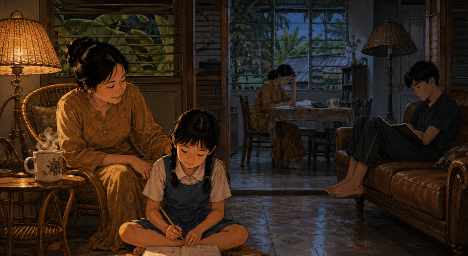
By Jaslin Kaur
Two children can grow up in the same home, with the same parents, and still experience entirely different childhoods.
One may remember a parent as emotionally available and playful.
Another may remember the same parent as overwhelmed, distant, or critical.
Not because one child is right and the other is wrong, but because families are constantly changing.
Parents move through stress, grief, financial pressure, burnout, conflict, healing, growth, and different stages of life. Children absorb these shifts differently depending on who they are, what role they take on in the family, and what the family needed at the time.
And often, this becomes the starting point for how we later understand:
- love
- safety
- closeness
- conflict
- emotional expression
- trust
- connection
Long before we enter romantic relationships or friendships, we are already learning:
How safe is it to need someone?
What happens when emotions are expressed?
Is love consistent or unpredictable?
Do I need to stay quiet, overachieve, take care of others, or avoid conflict to feel valued?
These experiences do not just stay inside the home.
They follow us into adulthood- shaping how we communicate, protect ourselves, respond to intimacy, and connect with others.
And yet, in many families, when one child grows up differently from the others, the conversation often becomes:
“I don’t know why this one turned out like that.”
As though children develop in isolation.
As though they are untouched by the emotional environments they grow up in.
What we hardly pause to ask instead is:
What version of us did this child experience?
Did they experience parents who were emotionally available or emotionally exhausted?
Did they grow up around warmth, tension, silence, unpredictability, criticism, or conflict avoidance?
What kind of marriage did they witness?
How was stress handled in the home?
What happened to anger, sadness, fear, or vulnerability when it appeared?
Children are constantly observing.
Not just what parents say to them but:
- how parents speak to each other
- how affection is shown
- how conflict is handled
- whether repair happens after conflict
- who carries the emotional stress in the family
Have you ever wondered why siblings in the same household take on very different roles?
One may become “the easy child” who asks for little.
One may become the achiever.
One may carry the anger no one else expresses.
One may become highly attuned to everyone else’s emotions while slowly disconnecting from their own.
These are not random personality traits.
Often, they are intelligent adaptations to the environment a child grew up in. Ways of maintaining connection, reducing conflict, staying safe, or finding belonging within the family system.
And many of these patterns continue into adulthood.
The child who learned love must be earned may overextend themselves in relationships.
The child who learned emotions create distance may struggle with vulnerability.
The child who grew up around unpredictability may become highly sensitive to shifts in tone, mood, or rejection.
Over time, people may begin describing themselves as:
“too sensitive,”
“too distant,”
“too needy,”
or “bad at relationships.”
But many of these ways of relating began as survival strategies long before they became adult patterns.
As a systemic and family therapist, I often encourage people to look beyond “What’s wrong with me?” and begin asking:
What experiences shaped the way I learned to relate, connect, protect, and survive?
Because our struggles do not develop in isolation and neither do we.